
Ashley Morris
Sorted a flat roof above a bay (in the photo). Excellent work, all completed professionally and quickly with no fuss. Highly recommended.

An owner-led electrical contractor in Swansea, led by Louis Furlong
Furlong BAU Limited is an owner-led electrical contractor based in Killay, Swansea, serving homeowners, landlords, and businesses across the city and the Gower. The business was founded by Louis Furlong, who came into the trade the way a lot of the best tradespeople do: on site from a young age, encouraged by a grandfather who was a builder his entire life.
Louis trained through a full electrical apprenticeship and spent several years gaining experience across domestic and commercial work, including subcontracting to established electrical firms, before completing the additional qualifications needed to set the business up properly and register with the NICEIC. That registration is where Furlong BAU really began.
Since then the business has grown steadily and carefully, taking on apprentices and adding vans to the road as the work has justified it. That measured approach is deliberate. The priority has always been the quality of the work and the relationships behind it, not chasing growth for its own sake.
We are NICEIC registered and a UKAS accredited approved contractor, and every job is carried out to the current BS 7671 regulations and properly certified. We do not compete on being the cheapest. We compete on doing a proper job, being straight with people, and standing behind our work, and the fact that most of our jobs still come through recommendation tells us that approach works.
Ashley Morris
Sorted a flat roof above a bay (in the photo). Excellent work, all completed professionally and quickly with no fuss. Highly recommended.
Ruth Gardner
Posted an electrical job on checkatrade to earth gas and water pipes. Furlong Bau Limited was the first to show an interest and very prompt to contact me to arrange a viewing and provide a quote. We were very pleased with their work - they worked efficiently, giving us advice and notice of what they were doing and cleared up afterwards. They were punctual to arrive and start the work and very respect and polite. They also provided all building certificates of work completed and would highly recommend. Thank you.
Robert Preddy
Had Louis diagnose and rectify a fault in our electrical wiring. Very methodical and professional approach, wouldn't hesitate to recommend.
shaun rees
Come and did some electrical work for me, really good job and very professional. Would recommend.
Simon Gregson
We recently engaged Louis Furlong to carry out some electrical work for us. He was very polite and attentive. He had some excellent ideas and explained everything about the job in hand.He also kept to the agreed timings.Would heartily recommend.
Stephney Davies
I had an ongoing problem with the floor of a balcony for some years which was leaking in to a hallway underneath it when it rained.I spoke to my house alarm man casually one day and he recommended Louis. After contacting Louis he promptly visited with his grandfather Pat and the job was expertly repaired within a few days and I haven’t had any problems in the area since.I would highly recommend this dynamic duo who were professional, clean and charming!
Anthea Jones
Louis was recommended to me by the Security Firm I have been dealing with for years and I was not disappointed. From start to finish he was professional, straightforward and could not have been more helpful. I am extremely pleased with the job he did upgrading my wired-in fire alarm system, clearly explaining to me any choices I may have had on the way. Giving 5 stars was the obvious choice. Highly recommended..
We cover Swansea and the surrounding area, including Killay, Sketty, Mumbles, Gowerton, Gorseinon, Morriston, and Neath. We are happy to travel further afield for the right work where the customer is happy to cover the additional travel costs. If you are not sure whether you are in our area, just call us on 07814 888747.
Yes. Furlong BAU Limited is a NICEIC registered contractor and a UKAS accredited approved contractor. All of our work is carried out to the latest BS 7671 wiring regulations and certified accordingly, so your installation is safe, compliant, and properly documented.
The business was founded by Louis Furlong, who came up through a full electrical apprenticeship and years of hands-on domestic and commercial experience before registering with the NICEIC. Furlong BAU has been operating as a NICEIC registered contractor for around three years and has grown steadily ever since.
Yes. We provide free, no-obligation quotes for all of our work. Call us on 07814 888747 or send us an email and we will arrange to assess the job and come back to you with a clear, transparent price.
Our standard hours are Monday to Friday 08:00 to 18:00 and Saturday 09:00 to 16:00. We are closed on Sundays. We can be flexible around larger and commercial jobs, including out-of-hours work, where it suits the project.
We accept bank transfer, card payments, and cash. Payment is usually taken on completion of the work, and for larger projects such as rewires we are happy to discuss a sensible staged payment arrangement.
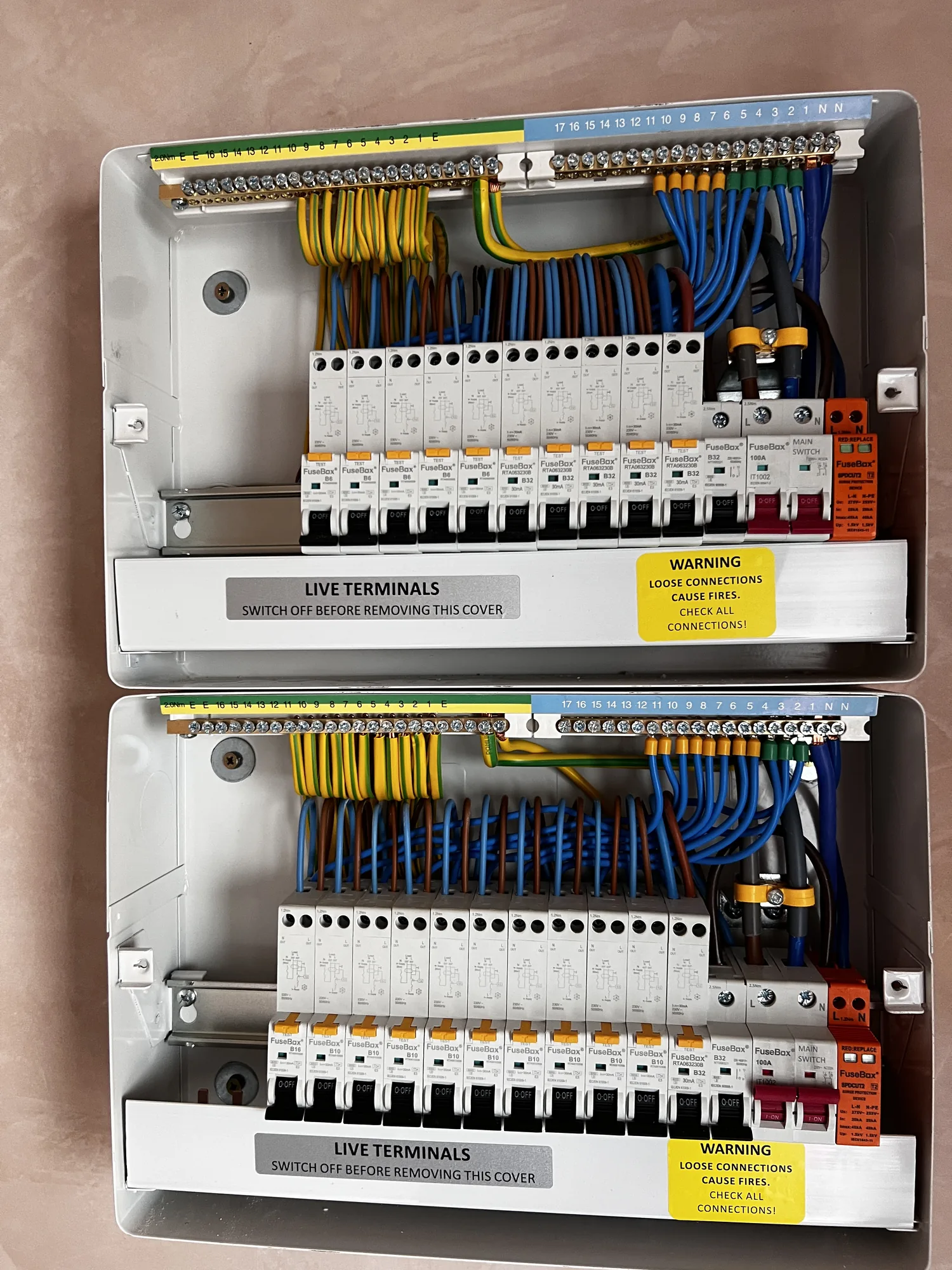
If your board is outdated or made of old materials such as a wooden backing or ceramic fuses, it may not meet modern safety standards and can pose risks like electrical fires, short circuits, or poor protection against overloads. A modern board adds RCD and MCB protection, which greatly reduces the risk of shocks and fires, and some home insurers expect an up-to-date board for cover.
A fuse is a single-use device that blows when the current exceeds a safe level and then has to be replaced. It is an older, less efficient form of protection. An MCB is a more reliable, reusable device that switches a circuit off automatically when it detects an overload or fault, and can simply be reset once the fault is cleared.
Typically four to eight hours, depending on the complexity of your installation and any additional work needed. That includes a full test of every circuit powered by the board before we leave.
We start with a survey of your existing setup, checking the wiring, circuits, and the condition of the current board. We then isolate the supply, remove the old board, fit the new one, and upgrade or correct any wiring needed so everything is properly labelled and compliant. Finally we test the board and all its circuits to confirm everything is working correctly and safely.
Yes. The power is completely turned off during the replacement to keep the work safe, so it is best to plan for a period without electricity, usually a few hours.
Yes. Every board we install complies with the latest amendment of the BS 7671 wiring regulations. This is exactly why the work should be done by a qualified, registered electrician, so you can be sure it is up to standard.
No. It is not legal for an unqualified person to replace a fuse board because of the risks involved. The work requires knowledge of electrical systems, the right tools and test equipment, and compliance with safety regulations, so it should always be carried out by a certified and competent electrician.
An RCD detects differences between the live and neutral currents. If there is an earth fault or someone receives a shock, it cuts off the supply within milliseconds to minimise harm. It is a crucial safety device for preventing serious electrical accidents.
A well-maintained board can last 20 to 30 years, but it is wise to replace one sooner if it is outdated or showing signs of wear. Regular inspections (EICRs) by a qualified electrician will help identify when a board is nearing the end of its life or needs replacing.
Watch for flickering lights, tripping circuit breakers, buzzing sounds, or overheating around the board. If the board is old and does not meet modern standards, or you have recently added high-power appliances, it is probably time for an upgrade.
Outdoor lighting enhances the look of your garden and highlights features like trees, planting, and water features. It improves security, since motion-sensor lights deter intruders, and safety, by lighting paths, steps, and entrances. It also extends the hours you can enjoy your outdoor space after dark.
There is a wide choice: pathway lighting to guide movement safely, spotlights and accent lighting for features, floodlights for larger areas and security, deck and patio lighting for living spaces, post and column lights for borders, string lights for atmosphere, and energy-efficient solar lights that need no wiring. We will help you pick the right mix for your garden.
For wired lighting that connects to your home's electrical system, yes, you need a qualified electrician to make sure it is installed safely and to current regulations. Solar-powered lights are the exception and can usually be fitted by the homeowner without any wiring.
Outdoor fittings are designed to withstand the weather, but always check the IP rating. IP44 or higher is fine for general outdoor use, IP65 or above is fully weatherproof for rain and snow, IP67 suits lights near water features, and IP68 is for heavy-duty or submerged use. We only fit fittings rated correctly for where they are going.
Yes. Many outdoor lights are designed for security, and motion-sensor lights are especially effective at deterring intruders because they light up when they detect movement. They work well near entry points, driveways, and darker corners of the garden.
Start by identifying the areas you want to highlight, such as paths, seating areas, and focal features. Layer ambient, task, and accent lighting to create depth, and avoid over-lighting so the garden keeps its charm at night. Timers or smart controls make the lighting more convenient and energy-efficient, and we will help plan all of this with you.
Choose LED fittings, which are far more efficient and longer-lasting than older bulbs. Smart controls let you manage brightness and timing, and motion sensors make sure lights only run when they are needed, which saves energy. We will recommend efficient options as standard.
In most cases no, unless the lighting is very large or would significantly affect neighbours. It is worth checking with your local council if you live in a listed building or a conservation area, or if there are specific local rules, and we can advise you on this.
Modern LED outdoor lights can last 20,000 to 50,000 hours, which is several years of normal use before they need replacing. Solar-powered lights typically last around five to ten years with proper maintenance.
Yes, outdoor lighting can generally be installed year round. For wired lighting, colder ground conditions can occasionally affect installation, so it is worth talking to us first so we can plan around any challenges.
An Electrical Installation Condition Report (EICR) is an assessment of the safety and condition of your electrical installation, carried out by a qualified electrician. It checks whether the system is safe, compliant, and working properly, and the report highlights any hazards or defects that need attention.
An EICR identifies hazards like faulty wiring, outdated equipment, or exposed cables that could lead to fires or shocks. Some insurers require one, particularly for rented and commercial property, and landlords are legally required to have one. It also confirms your installation complies with the BS 7671 wiring regulations.
For owner-occupied homes, every ten years is recommended. For rented property it is every five years, which is a legal requirement for landlords. Have one done sooner if you notice frequent trips, flickering lights, or other signs of trouble. A previous EICR will also state its own recommended re-test interval, which can be as short as one year depending on the condition of the installation.
We inspect and test the wiring, socket outlets and switches, earthing and bonding, and the consumer unit, and we check that fittings and appliances are safely connected. We then test the circuits to confirm they are working correctly and have the right protection in place.
The report details every finding with a code: C1 means danger present and immediate action is required, C2 means potentially dangerous and urgent action is needed, and C3 means improvement is recommended but it is not immediately dangerous. It also includes recommendations and an overall result of Satisfactory or Unsatisfactory.
A typical report takes two to four hours depending on the size of the property and the complexity of the system. Larger homes or buildings with multiple circuits and boards can take longer, sometimes more than a day.
An EICR must be carried out by a qualified, registered electrician who is competent in inspection and testing, and who is a member of a recognised body such as the NICEIC, NAPIT, or Elecsa. Furlong BAU is NICEIC registered.
Yes. Under the Electrical Safety Standards in the Private Rented Sector regulations, landlords are legally required to have an EICR carried out at least every five years to ensure the electrical system in rented property is safe for tenants.
If the report identifies C1 or C2 issues, you must take action to put them right. We will provide clear recommendations and a quote for the necessary work to bring the installation up to standard. Failing to address critical issues is a safety risk and, for landlords, can lead to fines or penalties.
Yes. C3 items are recommendations for improvement and you are not legally required to fix them immediately. It is still sensible to address them when you can, to keep the installation as safe and efficient as possible.
There is not much to do, but you can help by clearing access to the fuse board, sockets, and any areas we need to inspect, providing any previous electrical reports, and being available for questions or to give access to parts of the property during the inspection.
Yes. An EICR generally does not require the power to be off for long periods, so you can stay in the property. Some tests do need brief power shutdowns for safety, so it is worth not planning anything that depends on a constant supply during the inspection.
An EV charger is a device used to charge electric and plug-in hybrid vehicles. The most common type for home use is a Level 2 charger, which charges far faster and more efficiently than a standard domestic socket.
Yes. A dedicated EV charger is the safe and efficient option. You can technically use a standard outlet (Level 1), but it is much slower and not suitable for daily charging. A Level 2 charger gives faster charging times and is the right choice for home installations.
A Level 1 charger uses a standard 230V outlet and adds roughly 2 to 5 miles of range per hour, which only suits very light daily use. A Level 2 charger uses a higher-powered supply and adds around 10 to 60 miles of range per hour, which is far more practical for everyday home charging and overnight top-ups.
It varies with the charger and the complexity of the installation. A fully installed Level 2 charger generally costs between £800 and £1,200 or more, including the unit, installation, and any electrical upgrades needed. You may also be eligible for a government grant towards the cost, which we can guide you through.
Yes. EV charger installation is high-voltage work that must be carried out by a qualified, certified electrician to comply with UK electrical regulations. We make sure everything is up to code and meets the latest safety standards.
Usually between four and eight hours depending on the complexity of the job. If your installation needs upgrades, such as a new dedicated circuit or board, it can take a little longer.
Usually not in the way you might expect. We find most existing fuse boards are not suitable for an EV charger, so we plan and price every installation to include a new dedicated board for the charger. That removes any concern that the old installation will cause problems on the day. Occasionally, for smaller homes, the network operator may visit and upgrade the main fuse at their own expense if they decide it is needed.
No, this is not recommended unless you are a qualified electrician. EV charger installation involves high-power circuits and must be done safely to avoid hazards like electrical fires or shocks.
In most cases no, provided the charger is for domestic use, within your property boundary, and does not obstruct a public footpath or road. If you live in a listed building or a conservation area, check with your local council, and we can advise you on this.
Possibly minor ones, depending on where the charger goes. We may need to run a cable under the driveway to reach the parking area, for example. We always plan the installation to be as seamless as possible with minimal disruption.
There can be. Domestic grant schemes can contribute towards a home charger if you meet the eligibility criteria. For businesses, the OZEV-funded Workplace Charging Scheme covers 75% of purchase and installation costs, capped per socket for up to 40 sockets, where there is dedicated off-street parking. Applications are made through a government online portal, and we can point you in the right direction.
Level 2 chargers, the usual home choice, generally provide around 10 to 60 miles of range per hour depending on the power output and your vehicle's battery. Actual charging time varies with the size of your battery.
Yes, it increases your electricity usage, but it is far cheaper than fuelling a petrol or diesel car. A full charge typically costs a few pounds depending on your battery size and tariff, and a smart charger lets you schedule charging for cheaper off-peak rates overnight.
A domestic rewire replaces old or outdated wiring in your home with new, compliant wiring to keep it safe and functional. It is usually needed when the existing system no longer meets modern standards or has become a safety risk through age and wear.
Common reasons include old or unsafe wiring in a property more than around 25 years old, frequent electrical problems such as flickering lights or tripping breakers, wiring that cannot support modern appliances, or renovations and extensions that change the layout of the home.
Typical signs are frequent trips, flickering or dimming lights, an outdated or rewireable fuse box, burnt or discoloured sockets and switches, and shocks from sockets or appliances. If your home is over 25 years old and has not been rewired or significantly updated, it is worth a professional assessment, usually an EICR, to confirm exactly what needs doing.
It depends on the size and complexity of the property. A small to medium two or three bedroom home usually takes around 7 to 10 days, while larger or more complex properties can take 10 to 15 days or longer. We give you a specific estimate after the consultation.
It varies with the size of the home, the number of rooms, the fittings you choose, and the complexity of the work. As a guide, a full rewire of a standard two or three bedroom home falls in the region of several thousand pounds, and we provide a free, no-obligation quote with a detailed breakdown for your specific project.
For most full rewires it is recommended to move out, or at least stay away during the working day, particularly where the work is extensive. It keeps you safe, lets us work efficiently, and actually speeds the job up and reduces the cost. For smaller or partial rewires we work with you to keep disruption to a minimum.
Rewiring involves working with live circuits, which is exactly why it must be carried out by a qualified electrician. All of our electricians are fully trained, qualified, and work to recognised industry standards as a NICEIC registered contractor, and we take every precaution to carry the work out safely and to a high standard.
We start with a consultation and assessment of your current system and confirm what needs rewiring. We then prepare the property and routes, install new wiring throughout including new consumer units, sockets, switches, and circuits, and carry out a full test on completion. Finally we issue an Electrical Installation Certificate and a building control notification confirming the work meets the regulations.
In most cases yes. If your consumer unit is old or outdated it will need replacing with a modern board with RCD and MCB protection. Modern consumer units protect your home against electrical faults and reduce the risk of shocks and fires.
There will be some disruption, but we aim to keep it to a minimum. For larger rewires you may be without power in certain areas for short periods, and we will schedule the work with you to cause the least disruption to your routine.
Sometimes. Home insurance may cover a rewire if it is needed because of damage, fire, or another covered event, so it is always worth checking with your provider. Rewiring done as part of a renovation or upgrade is normally paid for by the homeowner.
Generally no. A domestic rewire is treated as maintenance and does not change the structure of the property, so planning permission is not usually required. If you live in a listed building or conservation area, check with your local council first, and we can advise you.
A rewire removes outdated or hazardous wiring and reduces the risk of fires and shocks. New wiring supports modern appliances and makes the home more efficient and future-proof, and a properly rewired home with a modern installation can also add to the property's value.
We take real pride in our work and are fully accredited by the NICEIC, so everything complies with the latest safety and wiring regulations. You receive a Certificate of Compliance and a building control notification, and all installations meet the current BS 7671 regulations. Even the hidden first fix is installed carefully, with routes planned and everything secured correctly, because the parts you never see matter just as much as the parts you do.
Commercial electrical work covers the design, installation, and maintenance of electrical systems in businesses, offices, retail spaces, and other commercial properties. That includes power distribution, lighting, wiring, emergency systems, and security installations: everything a commercial space needs to operate safely and efficiently. We provide full-service solutions tailored to your business.
Commercial systems are complex, heavily regulated, and the consequences of poor work are serious. Our qualified electricians make sure your systems are designed and installed to the UK wiring regulations (BS 7671), are energy-efficient, and are safe for your business and your employees.
We cover a wide range of work including power installations such as new circuits, distribution boards, and panels, energy-efficient and emergency lighting, data and communication cabling, exit signs and fire alarm provision, electrical testing and EICRs, and additional socket and equipment installations to suit commercial premises.
It depends on the size and complexity of the job. A typical installation for a medium office or retail unit takes around two to five days, while larger projects such as new builds or major refurbishments can take several weeks. We give you an estimated timeline at the consultation and work efficiently to minimise disruption.
It depends on the size of the space, the complexity of the requirements, and the type of work. Installing lighting or power in a small office might range from around £1,000 to £3,000, while larger installations in retail units or warehouses cost more. We provide a free, no-obligation quote after assessing your needs, with clear and transparent pricing.
Most commercial electrical work does not need planning permission unless it involves structural changes or alterations to the building's exterior, such as external lighting or signage. All installations must comply with UK building regulations and health and safety law, and we make sure any necessary approvals are obtained and the work meets the appropriate standards.
We carry out all installations in strict accordance with the 18th Edition of the IET Wiring Regulations (BS 7671) and local building regulations. On completion we provide a full Electrical Installation Certificate or condition report to verify compliance, so your business is operating safely and legally.
Yes. We know downtime costs money, so we offer flexible working including out-of-hours and weekend visits to keep disruption to a minimum. We agree the best times with you at the consultation and arrange the work around your operation.
Yes. We offer maintenance contracts and emergency call-out so your systems stay in good condition. Regular servicing helps catch issues before they cause downtime, and we can schedule regular inspections to keep everything compliant and up to code.
Contact us straight away if you have a problem such as a power cut, faulty outlet, or tripped circuit. We offer an emergency call-out service to deal with urgent issues and keep your business safe and operational, and we will get to you quickly to assess and resolve the fault.
We bring qualified, experienced electricians, full compliance and safety as standard, solutions tailored to your specific requirements, clear and competitive pricing with no hidden costs, and efficient working that minimises downtime and gets your systems running again quickly.
It is simple. Contact us for a free, no-obligation consultation. We will visit the property, assess your electrical needs, and provide a detailed quote, then work with you on a timeline that fits your schedule and start planning the installation.